We gave up our slip in the Westview Harbour. They only allow annual moorage, and we keep the Bayliner up at the cabin all winter. I called Beach Gardens, but they were already full. That was a huge surprise since visiting boaters seem down this year. I called Lund and Fran, the Harbour Master at the government dock, was very accommodating.
Showing posts with label Boating. Show all posts
Friday, May 22, 2009
Boating in to Lund BC
We gave up our slip in the Westview Harbour. They only allow annual moorage, and we keep the Bayliner up at the cabin all winter. I called Beach Gardens, but they were already full. That was a huge surprise since visiting boaters seem down this year. I called Lund and Fran, the Harbour Master at the government dock, was very accommodating.
Wednesday, April 8, 2009
Ancient Sea Water Trapped in Powell Lake
One of our favorite places in the world is Powell Lake, BC. We love it so much we have a home floating on it's surface, a float cabin. While seeking information about Powell Lake, we discovered the results of an oceanographic study conducted by the University of British Columbia in 1962 and 1972. Oceanographic?Powell Lake is one of the deepest lakes in BC with a recorded depth of 1,180 feet. It was created when glaciers scoured out its fjord shaped basin. If you travel up any of the inlets along the British Columbia coast, they look virtually the same as Powell Lake. The difference is they are filled with ocean water. In the case of Powell Lake,
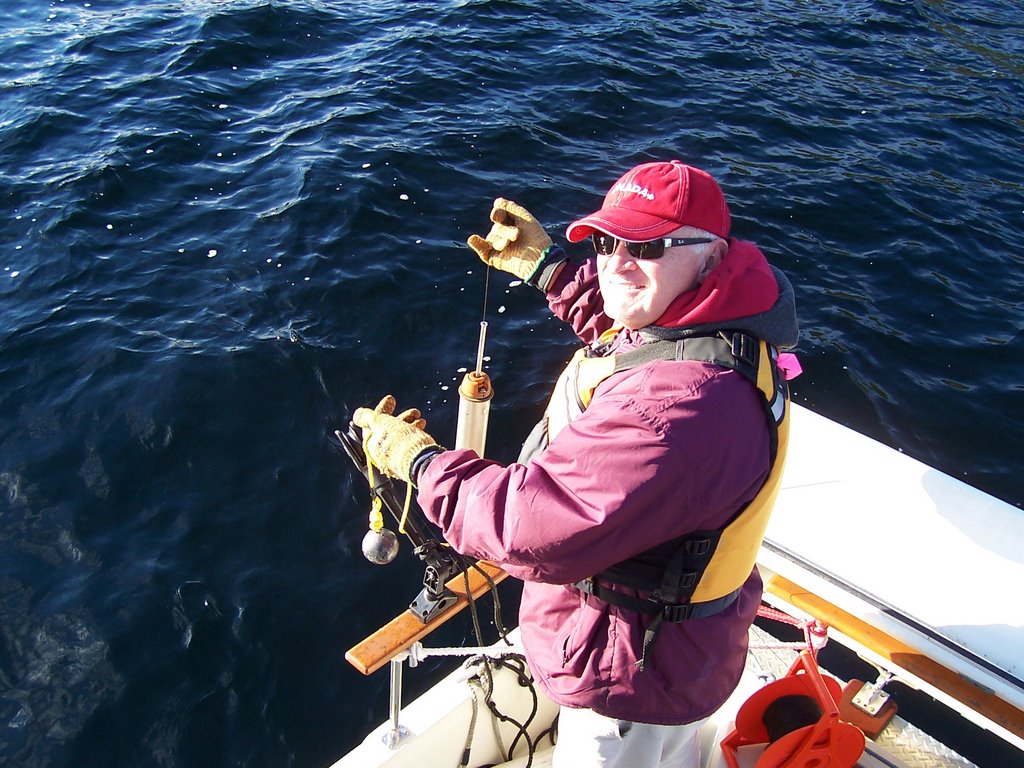
Yes, it was yellow and smelled of rotten eggs. We don't have the ability to conduct a chemical analysis, but a friend is helping with that as well. You just never know where your imagination can lead you. In our case, it led us back 10,000 years.
Want more information about the drop? Read Up the Strait, the newest book in the Coastal BC Stories series by Wayne J. Lutz. It is available at www.PowellRiverBooks.com. -- Margy
Sunday, March 29, 2009
CCGC Cape Caution
On Saturday, Wayne and I came to town. That afternoon, a storm front passed through with lots of strong wind. From our condo we watched the building swells and white caps and heard the loud clanging of sailboat tackle from the marina. I looked up just in time to see the Canadian Coast Guard heading back to port in Powell River's north harbour. I grabbed my camera and got some video of the men and women on the CCGC Cape Caution having a rough (but probably fun for them) day on the chuck.The Cape Caution is a 15 metre self-righting lifeboat used for search and rescue operations along the Strait of Geor
gia. She went through a commissioning ceremony when it arrived on Powell River on September 15, 2005, and is a regular fixture in our coastal waters. She can travel up to 100 nautical miles with a top speed of about 25 knots when needed. The men and women of the crew stay in one of the condos in our building and have their headquarters out front. It's good to know we have such wonderful neighbours.-- MargyWednesday, December 10, 2008
Upcoast Boating Adventures
Powell River, British Columbia, is a small coastal community on the Strait of Georgia.
Each summer our region is the destination for many boaters who are seeking upcoast adventures. They come from Seattle, throughout the Puget Sound, Vancouver and Victoria. Those of us who are locals also seek the pleasures of beautiful scenery and safe anchorages. Here are some of my favourite upcoast destinations.
Take several days to circumnavigate Quadra Island. You'll get a taste of tides and currents. In fact, make sure you go through Seymour Narrows at slack tide. Even the cruise ships traveling the inside passage don't mess with it.
For a piece of history, head on over to Refuge Cove. It has been a thriving outpost since the early logging, homesteading and fishing days.
Cortes Island has both marinas and anchorages to choose from. When we are looking for some dockside fun we head on over to Gorge Harbour.
I've saved my favourite for last. Theodosia Inlet is undiscovered by the summer crowds.
There is a protected spot at the entrance from which you can see beautiful vistas and watch loggers in action. You can read more about our upcoast boating adventures in Up the Strait available at www.PowellRiverBooks.com -- Margy
Each summer our region is the destination for many boaters who are seeking upcoast adventures. They come from Seattle, throughout the Puget Sound, Vancouver and Victoria. Those of us who are locals also seek the pleasures of beautiful scenery and safe anchorages. Here are some of my favourite upcoast destinations.Take several days to circumnavigate Quadra Island. You'll get a taste of tides and currents. In fact, make sure you go through Seymour Narrows at slack tide. Even the cruise ships traveling the inside passage don't mess with it.
For a piece of history, head on over to Refuge Cove. It has been a thriving outpost since the early logging, homesteading and fishing days.
Cortes Island has both marinas and anchorages to choose from. When we are looking for some dockside fun we head on over to Gorge Harbour.
There is a protected spot at the entrance from which you can see beautiful vistas and watch loggers in action. You can read more about our upcoast boating adventures in Up the Strait available at www.PowellRiverBooks.com -- Margy
Tuesday, December 2, 2008
That's My World: The Hulks
Powell River in Coastal BC started as a company town for the Powell River Company. Brooks, Scanlon & Obrien joined forces to form the Powell River Company, western Canada's first pulp and paper mill.
Powell River was selected for the location because of the close proximity of huge timber resources and a rushing river to be harnessed for power. The mill was started in 1908 and the first roll of paper was produced in 1912.
The Hulks have been a common sight in Powell River since they were installed to form a protective floating breakwater for the mill's log pond in the late 1940's. They are all concrete ships originally built as transports for supplies in World Wars I and II. All ten are the last remaining representatives of their class of ships. The Peralta, holds the honor as THE last concrete ship remaining from World War I.
In 2002 the mill, then owned by Pacifica Papers, eliminated it's pulping operations, but decided to keep the Hulks. They were reconfigured to make the pond smaller for barges of wood chips waiting for their turn in the mill.
The waters off the Powell River coast are deep. It would be expensive, if not impossible, to build a traditional breakwater around the area. The concrete ships sit low in the water, thus providing protection from heavy wave action, even during storms. Huge concrete anchors and massive chains hold the ships in place. Occasionally, however, they must be reset due to the corrosive action of rust and the power of the sea.
Here are some resources to find more history about the hulks:
The Powell River Museum
The Hulks: The Breakwater Ships of Powell River by John A Campbell
Shotcrete Repair of WWII Concrete Hulks
Pulp, Paper and People by Karen Southern and Peggy Bird
Powell River's First 50 Years by the Powell River News
TheSunshineCoast.com
And finally, a shot of the guardian of the pond and its historic Hulks.
I invite you to put Powell River on your list of places to visit. If you are planning a trip to the 2010 Winter Olympics, we are only two ferry rides away. If you want to see more exciting places from around the world, go to the "That's My World" website. -- Margy
Powell River was selected for the location because of the close proximity of huge timber resources and a rushing river to be harnessed for power. The mill was started in 1908 and the first roll of paper was produced in 1912.
The Hulks have been a common sight in Powell River since they were installed to form a protective floating breakwater for the mill's log pond in the late 1940's. They are all concrete ships originally built as transports for supplies in World Wars I and II. All ten are the last remaining representatives of their class of ships. The Peralta, holds the honor as THE last concrete ship remaining from World War I.
In 2002 the mill, then owned by Pacifica Papers, eliminated it's pulping operations, but decided to keep the Hulks. They were reconfigured to make the pond smaller for barges of wood chips waiting for their turn in the mill.
The waters off the Powell River coast are deep. It would be expensive, if not impossible, to build a traditional breakwater around the area. The concrete ships sit low in the water, thus providing protection from heavy wave action, even during storms. Huge concrete anchors and massive chains hold the ships in place. Occasionally, however, they must be reset due to the corrosive action of rust and the power of the sea.
Here are some resources to find more history about the hulks:The Powell River Museum
The Hulks: The Breakwater Ships of Powell River by John A Campbell
Shotcrete Repair of WWII Concrete Hulks
Pulp, Paper and People by Karen Southern and Peggy Bird
Powell River's First 50 Years by the Powell River News
TheSunshineCoast.com
And finally, a shot of the guardian of the pond and its historic Hulks.
I invite you to put Powell River on your list of places to visit. If you are planning a trip to the 2010 Winter Olympics, we are only two ferry rides away. If you want to see more exciting places from around the world, go to the "That's My World" website. -- Margy
Labels:
Boating,
history,
http://sangar-newstyles.blogspot.com/,
My World,
Powell River,
Travel Destinations
Subscribe to:
Posts (Atom)